
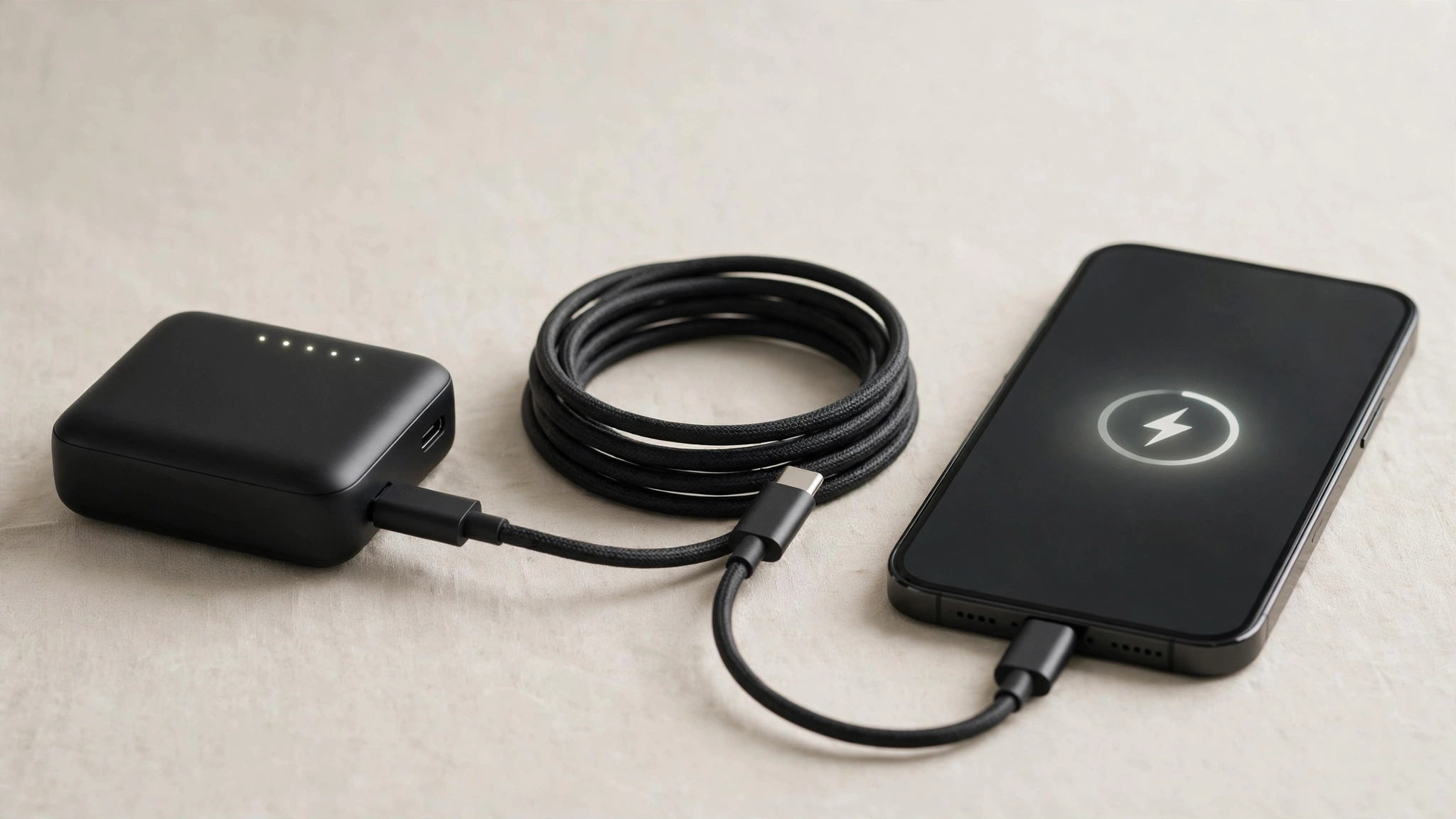
Load-shedding, long commutes, travel days — in Pakistan, a power bank isn’t an accessory, it’s essential gear. But the market is flooded with inflated numbers: a “20000mAh” bank that barely charges your phone one and a half times, “fast charging” that crawls, and no-name brands that swell or die within months. Here’s how to read the specs honestly and buy a power bank that actually delivers.
Capacity: The Number That Lies
Rated Capacity vs Real Output
The mAh printed on the box is the capacity of the internal battery cells — not what reaches your phone. Voltage conversion (3.7V cells → 5V USB output) plus circuit losses eat roughly 30–40%. So a 10000mAh bank delivers about 6000–6500mAh of usable charge — roughly 1.3–1.5 full charges for a typical 4500mAh phone battery. A 20000mAh bank gives you about 2.5–3 phone charges. Judge a power bank by this real output, not the headline number, and be deeply suspicious of absurdly cheap “50000mAh” banks — they are physically implausible at that size and price.
Pick Capacity for Your Actual Life
- 10000mAh: pocketable, ~1.5 phone charges. Perfect for daily carry and commutes.
- 20000mAh: ~3 phone charges or one phone + one tablet. Best for travel days and load-shedding evenings. Noticeably heavier.
- Above 20000mAh: only if you charge laptops or multiple devices for days — and check airline limits (usually 27000mAh / 100Wh max in cabin baggage).
Charging Speed: Watts Matter More Than mAh
A huge capacity means nothing if it charges at a trickle. Look for the output wattage: 18W is the practical minimum for decent phone charging in 2026, 22.5W–33W is the sweet spot, and 45W–65W+ matters only if you charge laptops or want maximum future-proofing. Just as important is input speed — how fast the bank itself recharges. A 20000mAh bank with slow 10W input takes 8+ hours to refill; with 18W+ input, that drops to 3–4 hours. Always check both numbers.
PD, QC, and What Your Phone Actually Supports
Fast-charging standards have silly names: PD (Power Delivery) is the universal standard (iPhones, Pixels, most laptops), while QC (Quick Charge) and proprietary standards (like some brands’ own 67W/120W systems) are brand-specific. A power bank only fast-charges your phone if they speak the same standard. Check your phone’s supported standard before paying extra for wattage you’ll never use.
Ports: Count What You’ll Actually Use
Most modern banks offer a mix of USB-C and USB-A. USB-C is the future — it handles both input and high-speed output — so prioritize banks where USB-C does the heavy lifting. Two output ports are genuinely useful (phone + earbuds simultaneously); four ports on a cheap bank usually means weak output shared across all of them. Also check whether ports can be used at full speed simultaneously — total output wattage is often lower than the sum of individual ports.
Safety: Don’t Skip This Section
You’re carrying a dense lithium battery in your bag and pocket — safety isn’t optional. Look for overcharge, over-discharge, short-circuit, and temperature protection (reputable brands list these). Certifications like CE, FCC, or RoHS are baseline signals of tested circuitry. Warning signs: a bank that gets hot during normal charging, a swollen or deformed casing (stop using it immediately), no brand name at all, or a price that seems impossible for the claimed capacity. Never buy swollen or damaged power banks secondhand.
If a 20000mAh “fast-charging” power bank costs less than a decent lunch, you’re not getting a bargain — you’re getting a fire risk with a nice label.
Brand Reliability and the Fake Problem
Pakistan’s market has a real counterfeit problem: convincing fakes of popular brands with recycled cells inside. Protect yourself: buy from authorized sellers or reputable stores, check for verifiable authenticity codes where brands offer them, and be wary of online listings priced far below market. Established brands with local warranty support are worth the small premium — a power bank is something you want a warranty on. User reviews mentioning “stopped working after 2 months” or “heats up” are disqualifiers, not bad luck.
What Your Budget Gets You in Pakistan
Typical 2026 ranges; prices fluctuate, so compare before buying.
- PKR 2,500 – 4,500: Basic 10000mAh banks, 10–18W. Fine for emergency top-ups; verify the brand.
- PKR 4,500 – 8,000: The sweet spot — 10000–20000mAh with 22.5W+ fast charging, USB-C PD, and proper safety circuitry from reliable brands.
- PKR 8,000 – 15,000: Premium 20000mAh+ banks, 45W–65W output, laptop charging, displays showing exact percentage, faster self-recharge.
Quick Recommendation
- Most people: a 10000–20000mAh bank from a reputable brand with 22.5W+ output, USB-C PD, and 18W+ input recharge speed.
- Travelers / load-shedding: 20000mAh, prioritize fast input speed so the bank itself refills quickly between outages.
- Laptop owners: only then consider 45W+ PD output — otherwise it’s wasted money and weight.
- Before buying: calculate real output (rated mAh × 0.65), match the fast-charge standard to your phone, and buy from a seller with warranty — never the cheapest no-name listing.
Frequently Asked Questions
Why doesn’t my 20000mAh power bank fully charge my phone 4 times?
Because the rated capacity isn’t the delivered capacity. After voltage conversion and efficiency losses, you get roughly 60–70% as usable output — about 2.5–3 full charges for a typical phone. That’s normal physics, not a defect.
Is fast charging bad for my phone’s battery?
Modern phones manage charging intelligently and heat is the real enemy, not speed itself. Using a quality bank with proper circuitry is safe; what damages batteries is cheap banks with unstable output and excessive heat.
Can I take a power bank on a flight?
Yes, in cabin baggage only — never in checked luggage. Most airlines cap at 100Wh (about 27000mAh); banks between 100–160Wh usually need airline approval. Check your airline’s policy before flying.
How long do power banks last?
A quality power bank lasts 2–4 years of regular use before capacity noticeably degrades. Leaving it fully drained or fully charged in heat for months shortens its life — store it around 50% charge if unused.
A power bank is one of those purchases where a little knowledge saves real money and frustration. Remember the 60–70% rule, buy speed you’ll actually use, respect the safety basics — and you’ll own a bank that works as hard as you do.


